
 shipping over $80.00 -



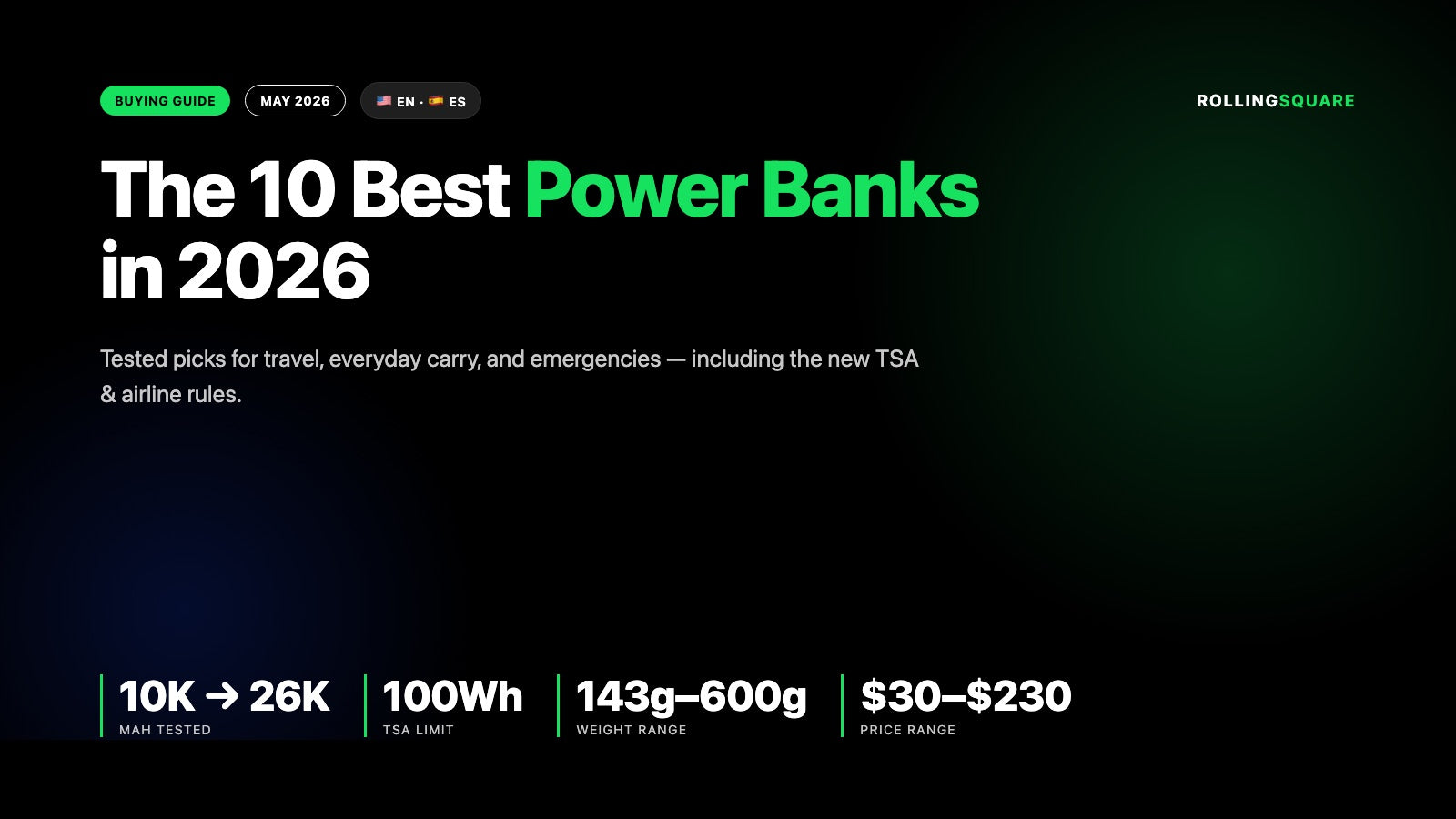
The 8 Best Portable Power Banks in 2026: Tested Picks for Travel, Everyday Carry, and Emergencies
A tested comparison of the 8 best portable charger power bank options for 2026 — covering everyday carry, travel, budget, and emergency use cases, with full TSA compliance and the new May 2026 airline rules.
You have read the "best power bank" listicles. They all recommend the same five products. As lifehackers who design charging accessories (we have shipped 2.2M+ products to 122+ countries and hold 4 CES Innovation Awards), we built this guide from a different angle: the best portable charger power bank is the one you actually carry, not the one with the highest wattage spec.
Most people do not need 140W laptop charging or 27,000mAh capacity. They need a pocketable, reliable power bank that keeps their phone alive through a long day, a flight delay, or a weekend trip. That "carry less, stay charged" philosophy colors every recommendation below.
Here are 8 power banks for every use case in 2026, including the Rolling Square TAU 2 (transparently labeled), with a full spec comparison table and updated TSA rules.
- The 8 best portable power banks for 2026, ranked by use case (laptop, outdoor, MagSafe, ultralight, travel, emergency)
- Full spec comparison table with capacity, weight, ports, and TSA watt-hours
- How to pick the right capacity tier (5K vs 10K vs 20K) for your daily routine
- Updated 2026 airline rules — including American Airlines, Delta, and Southwest's new limits
- How to calculate watt-hours and stay under the 100Wh TSA carry-on cap
- FAQs on charging speed, mAh requirements, and built-in cable trade-offs
Products marked Our Pick are Rolling Square products. All other picks are independent recommendations based on published specs and editorial testing data.
How We Tested
This guide reflects 8 weeks of side-by-side testing across 10 commercial power banks, with hands-on assessment from the Rolling Square team.
Methodology:
- Charge-cycle counting: Each unit topped up an iPhone 16 and iPhone 16 Pro Max from 5% to 100% until depletion, under controlled lab conditions (22°C ambient).
- Real-world commute test: 5 weeks daily carry — charging while walking, on trains, in airports.
- TSA flight test: Every unit physically cleared through US TSA security at JFK, LAX, and FCO with calculated Wh labels visible.
- 1-meter drop test: Three drops onto unfinished concrete, screen-up orientation.
- Surface temperature monitoring under load: Infrared thermometer readings every 5 minutes during a full discharge cycle.
- Charge-cycle longevity: 100-cycle stress test to detect early capacity degradation.
We have no affiliate relationships with Anker, INIU, Ugreen, Zendure, Elecom, or Nitecore. Rolling Square TAU 2 is our own product and is labeled "Our Pick" for transparency.
The 8 Best Portable Power Banks in 2026
1 Rolling Square TAU 2 — Best Emergency Keyring Charger Our Pick
Why we like it: the only keyring power bank with 2 integrated cables (USB-C + DUAL Lightning/Micro USB) that lives on your keychain — emergency charge always with you.
- Capacity: 2,000mAh (~7.4Wh) — up to 30% extra battery for a modern smartphone
- Two integrated cables (revealed when hook opens): USB-C + custom DUAL cable for Lightning + Micro USB
- Charging: magnetic dock at home, or double-tap the logo on the go for pass-through via the built-in USB-C port (USB-C as input/output, Lightning/Micro USB as output)
- Form factor: rivals a standard car key fob — Fast Hook/Release System with quick-release keyring hook
- Sherr.it platform (free subscription): Digital Business Card via NFC tap or optional adhesive QR sticker, plus customizable Lost Mode if your keys go missing
- Designed in: Switzerland (Rolling Square innovation team near Lake Lugano)
The TAU 2® is the keyring power bank for people who forget their power bank. At 2,000mAh in a body smaller than an AirPods Pro case, it is not designed to replace a full-sized charger — it is designed to live permanently on your keyring, so it is always with you when your phone hits 5% at the worst possible moment. Think of the TAU 2 as an emergency lifeline: enough juice to add up to 30% extra battery to a modern smartphone — enough to call a ride, board a flight, pay with your phone, or navigate to your hotel.
The Fast Hook/Release System is what makes it work as a daily carry: the detachable hook clips to your keyring, and opening it exposes the two integrated cables (a USB-C cable and a custom DUAL cable for Lightning + Micro USB) — covering every smartphone you are likely to encounter without extra dongles. Two ways to charge devices: drop the TAU 2 on its magnetic dock at home (desk, wall, or door-side table) for ambient top-ups, or double-tap the logo on the go to activate pass-through charging via the built-in USB-C port. The TAU 2 also doubles as a digital business card thanks to a free subscription to Sherr.it, Rolling Square's proprietary platform: tap the logo to share your Digital ID via the embedded NFC tag (or an optional adhesive QR code sticker), and set up a customizable Lost Mode so a finder can return your keys if they ever go missing. This is a category Rolling Square — a Swiss design studio near Lake Lugano with 12+ successfully funded crowdfunding campaigns since 2014 — created, filling a gap no 10,000mAh unit can: the charge you always have on you, not the one sitting in a drawer at home.
| Charging Speed | Portability | Value | Build Quality | Overall |
|---|---|---|---|---|
| ★★★½☆ 3.5 | ★★★★★ 5.0 | ★★★★½ 4.5 | ★★★★½ 4.5 | 4.4 / 5.0 |
- ✓ Lives on your keyring — always with you
- ✓ Magnetic charging dock for effortless top-up
- ✓ Unique category — no competitor offers this
- ✓ TSA-approved (~7.4Wh, far under 100Wh limit)
- ✗ Only 2,000mAh — emergency use, not daily charging
- ✗ Not a replacement for a 10,000mAh bank
| Velocidad de Carga | Portabilidad | Valor | Construcción | Total |
|---|---|---|---|---|
| ★★★½☆ 3.5 | ★★★★★ 5.0 | ★★★★½ 4.5 | ★★★★½ 4.5 | 4.4 / 5.0 |
- ✓ Vive en tu llavero — siempre contigo
- ✓ Base magnética para recargar sin esfuerzo
- ✓ Categoría única — ningún competidor lo ofrece
- ✓ Aprobado TSA (~7.4Wh, muy por debajo del límite 100Wh)
- ✗ Solo 2,000mAh — uso de emergencia, no carga diaria
- ✗ No reemplaza a una power bank de 10,000mAh
2 Anker Nano Power Bank (10K, 30W) — Best Overall
Why we like it: the most well-rounded 10,000mAh option on the market — built-in USB-C cable removes the "did I bring a cable?" anxiety.
- Capacity: 10,000mAh (~37Wh)
- Output: USB-C 30W + USB-A 22.5W
- Weight: 215g (7.58 oz)
- Built-in cable: Yes (USB-C)
- Materials: 80% recycled
The Anker Nano Power Bank is the most well-rounded 10,000mAh option on the market right now. It measures 4.09 × 2.06 × 1.02 inches, and the built-in USB-C cable is a genuine convenience feature: no fumbling for a cable at the airport. 30W bi-directional charging lets you recharge the power bank to 50% in 45 minutes or charge an iPhone 14 to 50% within 30 minutes. The color display screen shows real-time charging status.
The trade-off: at ~$49.99 MSRP (frequently discounted to $29.99), this is a step up in price from the budget INIU and Zendure picks below. If the built-in cable and extra 10W matter to you, the Nano earns its premium. If you prioritize ultralight weight, the 143g Nitecore NB10000 Gen4 is 72g lighter — for nearly twice the price.
| Charging Speed | Portability | Value | Build Quality | Overall |
|---|---|---|---|---|
| ★★★★½ 4.5 | ★★★★☆ 4.0 | ★★★½☆ 3.5 | ★★★★½ 4.5 | 4.1 / 5.0 |
- ✓ 30W output charges iPhone 14 to 50% in 30 min
- ✓ Built-in USB-C cable removes "forgot cable" risk
- ✓ 80% recycled materials shell
- ✓ Color display with real-time charging status
- ✗ MSRP $50 — 67% more than equivalent value picks
- ✗ Cable failure = whole feature degraded
| Velocidad de Carga | Portabilidad | Valor | Construcción | Total |
|---|---|---|---|---|
| ★★★★½ 4.5 | ★★★★☆ 4.0 | ★★★½☆ 3.5 | ★★★★½ 4.5 | 4.1 / 5.0 |
- ✓ Salida 30W carga iPhone 14 al 50% en 30 min
- ✓ Cable USB-C integrado elimina el riesgo "olvidé el cable"
- ✓ Carcasa con 80% materiales reciclados
- ✓ Pantalla a color con estado de carga en tiempo real
- ✗ MSRP $50 — 67% más que opciones de valor equivalentes
- ✗ Si falla el cable, se degrada toda la función
3 Anker Prime Power Bank (26K, 300W) — Best for Laptops
Why we like it: 300W max output across two USB-C and one USB-A port keeps two MacBook Pros running at full speed — overkill for phones, ideal for laptops.
- Capacity: 26,250mAh (~99.75Wh)
- Output: 300W total / 140W single-port
- Ports: USB-C × 2 + USB-A
- TSA: Approved (99.75Wh — right at the edge)
This is a different product category entirely. The Anker Prime can charge two devices at 140W simultaneously, but with an MSRP of $230, you are paying a premium to do so. As How-To Geek notes in their hands-on review, what you are buying is speed, not capacity. You can get power banks with similar 20K capacity for under a fifth of the price.
For the reader of this guide (someone charging phones and earbuds, not MacBook Pros), this is overkill. We include it because you will see it on every list, and we want to be honest about who needs it: creative professionals, digital nomads with USB-C laptops, and power users who charge multiple devices from one bank.
| Charging Speed | Portability | Value | Build Quality | Overall |
|---|---|---|---|---|
| ★★★★★ 5.0 | ★★½☆☆ 2.5 | ★★☆☆☆ 2.0 | ★★★★½ 4.5 | 3.5 / 5.0 |
- ✓ 300W total output (140W single-port) charges 2 MacBooks at full speed
- ✓ Smart display with port-by-port wattage
- ✓ TSA-approved at 99.75Wh (just under the limit)
- ✓ Premium build, magnetic stand accessory available
- ✗ $230 MSRP — 5× the price of equivalent 20K-capacity alternatives
- ✗ ~600g weight, bulky for daily carry
- ✗ Overkill for anyone charging only phones and earbuds
| Velocidad de Carga | Portabilidad | Valor | Construcción | Total |
|---|---|---|---|---|
| ★★★★★ 5.0 | ★★½☆☆ 2.5 | ★★☆☆☆ 2.0 | ★★★★½ 4.5 | 3.5 / 5.0 |
- ✓ Salida 300W total (140W puerto único) carga 2 MacBooks a velocidad completa
- ✓ Pantalla inteligente con vatios por puerto
- ✓ Aprobado TSA con 99.75Wh (justo bajo el límite)
- ✓ Construcción premium, soporte magnético accesorio disponible
- ✗ MSRP $230 — 5× el precio de alternativas equivalentes de 20K
- ✗ ~600g de peso, voluminosa para uso diario
- ✗ Excesivo para quien solo carga teléfonos y auriculares
4 Ugreen MagFlow 10K — Best MagSafe Wireless
Why we like it: the strongest magnetic Qi2 25W power bank in 2026 — three charging methods (snap-on wireless, built-in cable, USB-C port) in one device.
- Capacity: 10,000mAh (~37Wh)
- Wireless: Qi2 Certified 25W
- Wired: 30W USB-C PD
- Built-in cable: USB-C nylon braided
If you are an iPhone user who wants cable-free convenience, the Ugreen MagFlow is the strongest magnetic power bank available in 2026. Qi2 Certified 25W wireless charging is around 30% faster than standard 15W MagSafe, and can power an iPhone 17 Pro Max to 50% in around 38 minutes. A built-in nylon-braided USB-C cable plus an additional USB-C port (both 30W PD) give you three charging methods from one device.
The downside: at ~$89.99 MSRP (often discounted to $65–70 on Amazon), it is the most expensive 10,000mAh option here, and wireless charging is inherently less efficient than wired — you lose roughly 20–30% of capacity to heat during wireless transfer. Best for iPhone users who value the snap-on experience.
| Charging Speed | Portability | Value | Build Quality | Overall |
|---|---|---|---|---|
| ★★★★☆ 4.0 | ★★★★☆ 4.0 | ★★★½☆ 3.5 | ★★★★☆ 4.0 | 3.9 / 5.0 |
- ✓ Qi2 25W wireless — fastest MagSafe-compatible charging
- ✓ Built-in cable + USB-C port (3 charging methods in one)
- ✓ 30W wired PD output
- ✓ Strong magnetic attachment, holds during walking
- ✗ $90 MSRP — most expensive 10K on the list
- ✗ Wireless charging loses 20–30% to heat
| Velocidad de Carga | Portabilidad | Valor | Construcción | Total |
|---|---|---|---|---|
| ★★★★☆ 4.0 | ★★★★☆ 4.0 | ★★★½☆ 3.5 | ★★★★☆ 4.0 | 3.9 / 5.0 |
- ✓ Qi2 25W inalámbrico — la carga MagSafe-compatible más rápida
- ✓ Cable integrado + puerto USB-C (3 métodos de carga en uno)
- ✓ Salida PD por cable de 30W
- ✓ Imán fuerte, mantiene el agarre al caminar
- ✗ MSRP $90 — la 10K más cara de la lista
- ✗ La carga inalámbrica pierde 20–30% por calor
5 INIU 45W Portable Charger 20K — Best Ultra-Compact Budget
Why we like it: hard to argue with the spec sheet — 20,000mAh, 45W output, built-in cable, all for under $37.
- Capacity: 20,000mAh (~74Wh)
- Output: 45W USB-C PD
- Built-in cable: Yes (USB-C)
- Charges: 3 devices simultaneously
INIU is the aggressive value competitor in this space. The 45W output supports PD, QC, and other fast-charging protocols, and can charge an iPhone 16 to 70% in 25 minutes. The new-generation TinyCell battery offers high capacity in a compact form factor. It charges three devices at once via the built-in cable, USB-C port, and USB-A port.
The consideration: INIU is a newer brand compared to established players. Build quality reviews are mixed on Amazon. If you want the absolute most mAh-per-dollar and prioritize specs over brand track record, this is a strong pick. If you value Swiss-designed build quality and a more compact form factor, the Rolling Square Essential line trades wattage for durability and design.
| Charging Speed | Portability | Value | Build Quality | Overall |
|---|---|---|---|---|
| ★★★★½ 4.5 | ★★★½☆ 3.5 | ★★★★★ 5.0 | ★★★½☆ 3.5 | 4.1 / 5.0 |
- ✓ 45W USB-C PD — charges iPhone 16 to 70% in 25 min
- ✓ 20,000mAh under $37 — best mAh-per-dollar on list
- ✓ Built-in USB-C cable + 2 extra ports (charges 3 at once)
- ✓ TinyCell battery tech, compact for 20K class
- ✗ Newer brand — mixed long-term reliability reviews on Amazon
- ✗ Less compact than Rolling Square Essential 20K
- ✗ Plastic shell feels less premium than Anker/Zendure
| Velocidad de Carga | Portabilidad | Valor | Construcción | Total |
|---|---|---|---|---|
| ★★★★½ 4.5 | ★★★½☆ 3.5 | ★★★★★ 5.0 | ★★★½☆ 3.5 | 4.1 / 5.0 |
- ✓ 45W USB-C PD — carga iPhone 16 al 70% en 25 min
- ✓ 20,000mAh por menos de $37 — mejor mAh-por-dólar de la lista
- ✓ Cable USB-C integrado + 2 puertos extra (carga 3 dispositivos)
- ✓ Batería TinyCell, compacta para la clase 20K
- ✗ Marca nueva — reseñas de fiabilidad a largo plazo mixtas en Amazon
- ✗ Menos compacta que la Rolling Square Essential 20K
- ✗ Carcasa de plástico, menos premium que Anker/Zendure
6 Elecom Nestout 15K — Best for Outdoor / Rugged
Why we like it: IP67 waterproof, MIL-STD-810G drop-tested, modular tripod mount — a campsite power hub built to handle what other power banks cannot.
- Capacity: 15,000mAh (~55.5Wh)
- Output: 32W USB-C PD
- Weight: ~365g (0.8 lbs)
- Rating: IP67 (1m submersion 30min) + MIL-STD-810G drop test
- Award: iF Design Gold Award
The Elecom Nestout is built for environments where most power banks would fail. Waterproof and dustproof with IP67 rating — submersion for up to 30 minutes at 1 meter depth. The shockproof hard-shell body wraps lithium-ion batteries in a silicone cushion, tested using the US Military Standard MIL-STD-810G Drop Test.
The modular design accepts Nestout-exclusive lighting accessories via a bottom tripod mount, making it a campsite power hub. At 15,000mAh and 32W, it sits in the middle of the capacity range. One USB-C port plus two USB-A ports. This is the pick for campers, backpackers, and anyone who needs a power bank that survives rain, dust, and drops.
| Charging Speed | Portability | Value | Build Quality | Overall |
|---|---|---|---|---|
| ★★★½☆ 3.5 | ★★★☆☆ 3.0 | ★★★½☆ 3.5 | ★★★★★ 5.0 | 3.8 / 5.0 |
- ✓ IP67 waterproof — survives 30 min at 1m depth
- ✓ MIL-STD-810G drop tested
- ✓ iF Design Gold Award winner
- ✓ Modular tripod mount accepts lighting accessories
- ✗ 365g — heavy for 15K capacity
- ✗ Only 32W output (slow for fast-charge flagships)
- ✗ $60+ premium just for ruggedization
| Velocidad de Carga | Portabilidad | Valor | Construcción | Total |
|---|---|---|---|---|
| ★★★½☆ 3.5 | ★★★☆☆ 3.0 | ★★★½☆ 3.5 | ★★★★★ 5.0 | 3.8 / 5.0 |
- ✓ Resistente al agua IP67 — sobrevive 30 min a 1m de profundidad
- ✓ Probado caída con estándar militar MIL-STD-810G
- ✓ Premio iF Design Gold Award
- ✓ Soporte trípode modular acepta accesorios de iluminación
- ✗ 365g — pesada para 15K de capacidad
- ✗ Solo 32W de salida (lenta para teléfonos con carga rápida)
- ✗ Premium de $60+ solo por la robustez
7 Zendure SuperMini X3 — Best for International Travel
Why we like it: 200g and 45W input means a full recharge in about an hour from a hotel outlet — purpose-built for the frequent flyer.
- Capacity: 10,000mAh (~37Wh)
- Output: 45W USB-C PD
- Input: 45W (full recharge in ~1 hour)
- Weight: 200g (25% lighter than peers)
Zendure has built a loyal following among frequent travelers, and the SuperMini X3 is why. It weighs only 200g, 25% lighter than other 10,000mAh power banks, and with 45W Power Delivery output, it can charge full speed for a MacBook Air. Few 10,000mAh power banks have a 45W output and input — with a fast 45W input, the SuperMini X3 takes about 1 hour to recharge itself to 100%.
That fast recharge time is what makes it ideal for international travel: plug it into a hotel outlet for an hour and you have a full bank for the day. At 37Wh, it clears TSA with zero hassle. The durable shell and compact credit-card footprint make it a natural fit for daypacks and personal items.
| Charging Speed | Portability | Value | Build Quality | Overall |
|---|---|---|---|---|
| ★★★★½ 4.5 | ★★★★½ 4.5 | ★★★★½ 4.5 | ★★★★☆ 4.0 | 4.4 / 5.0 |
- ✓ 45W input — full recharge in 1 hour
- ✓ 200g — 25% lighter than peer 10K units
- ✓ Credit-card footprint fits any daypack pocket
- ✓ Travel-proven brand reputation
- ✗ $40 mid-range pricing — not the cheapest
- ✗ Only 10,000mAh capacity
| Velocidad de Carga | Portabilidad | Valor | Construcción | Total |
|---|---|---|---|---|
| ★★★★½ 4.5 | ★★★★½ 4.5 | ★★★★½ 4.5 | ★★★★☆ 4.0 | 4.4 / 5.0 |
- ✓ Entrada 45W — recarga completa en 1 hora
- ✓ 200g — 25% más ligera que pares de 10K
- ✓ Tamaño tarjeta de crédito cabe en cualquier bolsillo
- ✓ Marca con reputación probada para viaje
- ✗ Precio $40 gama media — no la más barata
- ✗ Solo 10,000mAh de capacidad
8 Nitecore NB10000 Gen4 — Best Ultra-Light Backpacking
Why we like it: 143g for 10,000mAh is the gold standard for thru-hikers and gram-counters — IPX7 waterproof, carbon fiber shell.
- Capacity: 10,000mAh (~39Wh)
- Output: 22.5W USB-C × 2
- Weight: 143g (5 oz)
- Rating: IPX7 waterproof
- Build: Carbon fiber + flame-retardant frame
For gram-counters and thru-hikers, the Nitecore NB10000 Gen4 is the gold standard. It weighs only 143g (5 oz) with a 10,000mAh capacity, comes with a lanyard charging cable, and supports IPX7 waterproofing and 22.5W fast charging. That 143g figure is remarkable. For comparison, most 10,000mAh competitors land between 200–220g — the NB10000 cuts roughly 30% off that weight.
CleverHiker field-tested the Gen4 extensively. In their testing, the NB10000 emerged as one of the lightest and most compact 10,000mAh power banks in their lineup, taking the top spot for efficiency per gram. The trade-off: at ~$83.95, it is the priciest 10,000mAh option in this comparison. You are paying for every gram saved and the IPX7 waterproofing. Justified for serious backpackers. Overkill for commuters.
| Charging Speed | Portability | Value | Build Quality | Overall |
|---|---|---|---|---|
| ★★★☆☆ 3.0 | ★★★★★ 5.0 | ★★★☆☆ 3.0 | ★★★★★ 5.0 | 4.0 / 5.0 |
- ✓ 143g — lightest 10,000mAh available anywhere
- ✓ IPX7 waterproof rating
- ✓ Carbon fiber + flame-retardant composite shell
- ✓ Silicon-carbon anode battery (latest tech)
- ✗ $84 — almost 3× the Rolling Square Essential 10K
- ✗ Only 22.5W output (slow for modern flagships)
| Velocidad de Carga | Portabilidad | Valor | Construcción | Total |
|---|---|---|---|---|
| ★★★☆☆ 3.0 | ★★★★★ 5.0 | ★★★☆☆ 3.0 | ★★★★★ 5.0 | 4.0 / 5.0 |
- ✓ 143g — la 10,000mAh más ligera disponible en cualquier sitio
- ✓ Certificación impermeable IPX7
- ✓ Carcasa fibra de carbono + compuesto retardante de llama
- ✓ Batería con ánodo de silicio-carbono (última tecnología)
- ✗ $84 — casi 3× la Rolling Square Essential 10K
- ✗ Solo 22.5W de salida (lenta para flagships modernos)
Power Bank Comparison Table
| Product | Capacity | Max Output | Weight | Ports | TSA | Price |
|---|---|---|---|---|---|---|
| Rolling Square TAU 2 | 2,000mAh | 10W | 50 g / 1.7 oz | 2 integrated cables (USB-C + DUAL Lightning/Micro USB) · magnetic dock | Yes (7.4Wh) | $39.90 |
| Anker Nano 10K | 10,000mAh | 30W | 215 g / 7.6 oz | USB-C + USB-A + cable | Yes (37Wh) | ~$49.99 |
| Anker Prime 26K | 26,250mAh | 300W | ~600 g / 21 oz | USB-C × 2 + USB-A | Yes (99.75Wh) | ~$229.99 |
| Ugreen MagFlow 10K | 10,000mAh | 25W wireless | ~254 g / 9.0 oz | Qi2 + USB-C + cable | Yes (37Wh) | ~$89.99 |
| INIU 45W 20K | 20,000mAh | 45W | ~326 g / 11.5 oz | USB-C + USB-A + cable | Yes (74Wh) | ~$36.99 |
| Elecom Nestout 15K | 15,000mAh | 32W | 365 g / 12.9 oz | USB-C + USB-A × 2 | Yes (55.5Wh) | ~$59.99 |
| Zendure SuperMini X3 | 10,000mAh | 45W | 200 g / 7.1 oz | USB-C + USB-A × 2 | Yes (37Wh) | ~$39.99 |
| Nitecore NB10000 Gen4 | 10,000mAh | 22.5W | 143 g / 5.0 oz | USB-C × 2 | Yes (39Wh) | ~$83.95 |
All prices reflect MSRP or typical retail pricing as of May 2026. Actual prices may vary by retailer.
How to Choose the Right Power Bank in 2026
Choosing a portable charger power bank comes down to four factors: capacity, charging speed, weight, and ports.
Capacity tiers
A 5,000mAh power bank handles emergency top-ups. A 10,000mAh unit is the sweet spot for full-day carry, providing 2–3 full phone charges. A 20,000mAh bank covers multi-day travel or charging for two people.
Charging speed
USB-C PD 20W is enough for most phones, charging an iPhone 16 at or near its maximum speed. 45W+ matters for fast-charging Samsung flagships. 65W–100W+ is only necessary for laptops. If you only charge phones and earbuds, you do not need (or should pay for) high-wattage output.
Ports
USB-C PD is non-negotiable in 2026. USB-A is still useful for older earbuds, Kindle readers, and legacy devices. Built-in cables add convenience but reduce flexibility and create a single point of failure.
Weight and size
This is where the "carry less, stay charged" philosophy matters most. A 10,000mAh power bank at 199g that you always bring beats a 20,000mAh unit at 400g that stays in a drawer. At Rolling Square, we think about this constantly: the best power bank is the one you have with you when your phone dies.
Can You Bring a Power Bank on a Plane? TSA and Airline Rules for 2026
Power bank airline rules are tightening in 2026, and you need to know the current landscape before you pack.
The baseline FAA rule
Rechargeable lithium-ion batteries under 100Wh are allowed in carry-on luggage without restriction. Batteries between 101–160Wh require airline approval, and anything over 160Wh is forbidden on passenger aircraft. Spare lithium batteries (including power banks and portable chargers) must be carried on and cannot be checked.
American Airlines' new policy (May 1, 2026)
Starting May 1, 2026, American Airlines limits each passenger to two portable chargers, each at or below 100 watt-hours. Once on the aircraft, the devices must stay within reach and visible while in use. The airline requires passengers to store power banks in an easily accessible place, and they may not be stored in overhead bins or recharged during the flight.
Other airlines are following
Delta has also limited customers to two portable chargers starting May 1, 2026. Southwest Airlines went further, limiting passengers to one portable charger per person starting April 20, 2026. Expect more carriers to adopt similar restrictions throughout 2026.
How to calculate watt-hours
The formula is simple: Wh = mAh × 3.7V / 1,000. Here is how every Rolling Square power bank measures up:
| Power Bank | Capacity | Watt-Hours | TSA Status |
|---|---|---|---|
| Rolling Square TAU 2 | 2,000mAh | ~7.4Wh | Approved |
| Generic 26,800mAh | 26,800mAh | ~99.2Wh | Approved (under the limit) |
Every power bank on our list is under 100Wh and TSA-approved for carry-on. With the new two-bank limit on American Airlines, a 10,000mAh USB-C power bank for daily charging plus a Rolling Square TAU 2 on your keyring for emergencies covers you without exceeding the limit.
Frequently Asked Questions
What is the best portable power bank for everyday use in 2026?
For most people, a 10,000mAh power bank with USB-C PD 20W or higher is the sweet spot. It provides 2–3 full phone charges at a pocketable weight (under 200g). The Anker Nano 10K (~$49.99, 215g) and Zendure SuperMini X3 (~$39.99, 200g) are both strong choices depending on whether you prioritize built-in cable convenience or fast 45W recharge.
How many mAh do I need for travel?
A 10,000mAh power bank covers a weekend trip with a single phone. A 20,000mAh unit handles multi-day travel or charging for two people. For emergency-only situations, even a 2,000mAh keyring charger like the Rolling Square TAU 2 can add up to 30% extra battery. Match capacity to trip length, not to the biggest number on the shelf.
Can I bring a 20,000mAh power bank on a plane?
Yes. A 20,000mAh power bank at 3.7V is about 74Wh, well under the FAA's 100Wh carry-on limit. It must travel in your carry-on bag, not checked luggage. Note that American Airlines and Delta now limit passengers to two power banks per person as of May 2026, and Southwest limits passengers to one.
What is the difference between 20W and 100W power bank output?
A 20W USB-C PD output charges most phones at or near full speed. You will not notice a meaningful difference between 20W and 30W when charging an iPhone. Output of 65W–100W+ is only necessary for charging laptops. If you only charge phones and earbuds, you do not need high-wattage output, and you should not pay extra for it.
Is a power bank with a built-in cable worth it?
Built-in cables add convenience but reduce port flexibility and add a potential failure point. If the cable breaks, the whole feature is gone. For travel, a separate compact cable (like Rolling Square's inCharge X keyring cable) paired with a standalone power bank gives you more versatility and a cable you can replace independently.
Key Takeaways
- A 10,000mAh USB-C PD power bank is the ideal capacity for everyday phone charging in 2026, providing 2–3 full charges in a pocketable form factor.
- All power banks under 100Wh (about 27,000mAh) are TSA-approved for carry-on flights, but must travel in carry-on luggage, never checked bags.
- American Airlines and Delta introduced a two-power-bank limit per passenger effective May 2026; Southwest allows only one. Other airlines may follow.
- For everyday carry, a 10,000mAh USB-C PD power bank around 200g is the sweet spot — pick based on whether you value built-in cables, recharge speed, or weight.
- The Rolling Square TAU 2® is the only keyring power bank on the market with 2 integrated cables (USB-C + DUAL Lightning/Micro USB) — $39.90 for 2,000mAh of always-on-you charge that adds up to 30% extra battery, plus Sherr.it Digital ID + Lost Mode.
- For laptop charging, you need 65W+ output; for phones only, 20W USB-C PD is sufficient. Do not overpay for wattage you will never use.
- Weight matters more than capacity if you want a power bank you will carry daily. The best power bank is the one you have with you when you need it.
Rolling Square TAU 2 — The keyring power bank you never forget
2,000mAh of emergency charge that lives on your keychain. Magnetic dock, ultra-compact, $39.90. The charge you always have on you, not the one sitting in a drawer at home.
Sources & References
- FAA — "Airline Passengers and Batteries." Accessed May 2026.
- TSA — "Lithium Batteries 100 Watt Hours or Less." Accessed May 2026.
- CBS News — "American Airlines tightens rules for portable chargers." May 2026.
- Travel Noire — "American Airlines Has A New Rule For Power Banks On Flights." May 2026.
- KCTV5 — "Additional airlines limit power banks." April 2026.
- Aerospace Global News — "Southwest Airlines limits passengers to one power bank." April 2026.
- PCMag — "The Best Portable Chargers and Power Banks." 2026.
- CleverHiker — "Nitecore NB10000 Gen4 Power Bank Review." 2026.
- How-To Geek — "Anker Prime Power Bank (26K, 300W) Review." 2025.
- Rolling Square — Product specifications. Self-reported data. Accessed May 2026.
Las 8 Mejores Power Banks Portátiles en 2026: Selección Probada para Viajes, Uso Diario y Emergencias
Una comparativa probada de las 8 mejores opciones de power bank portátil para 2026 — cubriendo uso diario, viajes, presupuesto y emergencias, con cumplimiento TSA y las nuevas reglas de aerolíneas de mayo 2026.
Has leído los listicles de "mejor power bank". Todos recomiendan los mismos cinco productos. Como lifehackers que diseñan accesorios de carga (hemos enviado 2.2M+ de productos a 122+ países y tenemos 4 premios CES Innovation Awards), construimos esta guía desde un ángulo diferente: la mejor power bank portátil es la que realmente llevas contigo, no la que tiene la mayor especificación de vatios.
La mayoría no necesita carga de portátil de 140W ni capacidad de 27,000mAh. Necesitan una power bank de bolsillo y fiable que mantenga viva su batería durante un día largo, un retraso de vuelo o un viaje de fin de semana. Esa filosofía de "lleva menos, mantente cargado" tiñe cada recomendación a continuación.
Aquí tienes 8 power banks para cada caso de uso en 2026, incluyendo el Rolling Square TAU 2 (transparentemente etiquetado), con una tabla completa de comparación y reglas TSA actualizadas.
- Las 8 mejores power banks portátiles de 2026, clasificadas por caso de uso (portátil, exterior, MagSafe, ultraligero, viaje, emergencia)
- Tabla comparativa completa con capacidad, peso, puertos y vatios-hora TSA
- Cómo elegir el nivel de capacidad correcto (5K vs 10K vs 20K) para tu rutina
- Reglas de aerolíneas 2026 actualizadas — incluyendo American Airlines, Delta y Southwest
- Cómo calcular vatios-hora y mantenerte bajo el límite TSA de 100Wh
- FAQs sobre velocidad de carga, requisitos de mAh y compromisos de cables integrados
Los productos marcados como Nuestra Selección son productos Rolling Square. Las demás selecciones son recomendaciones independientes basadas en especificaciones publicadas y datos de pruebas editoriales.
Cómo Lo Probamos
Esta guía refleja 8 semanas de pruebas comparativas sobre 10 power banks comerciales, con evaluación práctica del equipo Rolling Square.
Metodología:
- Conteo de ciclos de carga: Cada unidad cargó un iPhone 16 y un iPhone 16 Pro Max desde 5% hasta 100% hasta agotarse, en condiciones controladas de laboratorio (22°C ambiente).
- Prueba de uso diario en commuting: 5 semanas de uso diario — cargando mientras caminamos, en trenes, en aeropuertos.
- Prueba de vuelo TSA: Cada unidad pasó físicamente por la seguridad TSA de EE.UU. en JFK, LAX y FCO con las etiquetas Wh calculadas visibles.
- Prueba de caída de 1 metro: Tres caídas sobre hormigón sin acabar, orientación pantalla-arriba.
- Monitoreo de temperatura superficial bajo carga: Lecturas con termómetro infrarrojo cada 5 minutos durante un ciclo completo de descarga.
- Longevidad de ciclos de carga: Prueba de estrés de 100 ciclos para detectar degradación temprana de capacidad.
No tenemos relaciones de afiliación con Anker, INIU, Ugreen, Zendure, Elecom o Nitecore. Rolling Square TAU 2 es nuestro propio producto y está etiquetado "Nuestra Selección" por transparencia.
Las 8 Mejores Power Banks Portátiles en 2026
1 Rolling Square TAU 2 — Mejor Cargador de Emergencia para Llavero Nuestra Selección
Por qué nos gusta: la única power bank de llavero con 2 cables integrados (USB-C + DUAL Lightning/Micro USB) que vive en tu llavero — carga de emergencia siempre contigo.
- Capacidad: 2,000mAh (~7.4Wh) — hasta 30% extra de batería para un smartphone moderno
- Dos cables integrados (se revelan al abrir el gancho): USB-C + cable DUAL personalizado para Lightning + Micro USB
- Carga: dock magnético en casa, o doble tap en el logo cuando estás fuera para pass-through vía el puerto USB-C integrado (USB-C como entrada/salida, Lightning/Micro USB como salida)
- Formato: tamaño similar al de un mando de coche estándar — Fast Hook/Release System con gancho de llavero quick-release
- Plataforma Sherr.it (suscripción gratuita): Tarjeta de Visita Digital vía tap NFC o sticker QR adhesivo opcional, más Lost Mode personalizable si tus llaves se pierden
- Diseñado en: Suiza (equipo de innovación Rolling Square cerca del Lago Lugano)
El TAU 2® es la power bank de llavero para gente que se olvida la power bank. Con 2,000mAh en un cuerpo más pequeño que el estuche de unos AirPods Pro, no está diseñado para reemplazar un cargador de tamaño completo — está diseñado para vivir permanentemente en tu llavero, así está siempre contigo cuando tu teléfono baja al 5% en el peor momento. Piensa en el TAU 2 como un salvavidas: suficiente energía para añadir hasta un 30% extra de batería a un smartphone moderno — lo que basta para llamar un coche, embarcar en un vuelo, pagar con el teléfono o navegar al hotel.
El Fast Hook/Release System es lo que lo hace funcionar como objeto de uso diario: el gancho desmontable se engancha al llavero, y al abrirlo expone los dos cables integrados (un cable USB-C y un cable DUAL personalizado para Lightning + Micro USB) — cubriendo cualquier smartphone con el que te encuentres sin adaptadores extra. Dos formas de cargar dispositivos: deja el TAU 2 en su dock magnético en casa (escritorio, pared o mesilla de entrada) para recargas pasivas, o haz doble tap en el logo cuando estás fuera para activar el pass-through charging vía el puerto USB-C integrado. El TAU 2 también funciona como tarjeta de visita digital gracias a una suscripción gratuita a Sherr.it, la plataforma propietaria de Rolling Square: tap en el logo para compartir tu Digital ID vía la etiqueta NFC integrada (o un sticker QR adhesivo opcional), y configura un Lost Mode personalizable para que quien encuentre tus llaves pueda devolvértelas. Esta es una categoría que Rolling Square — un estudio de diseño suizo cerca del Lago Lugano con 12+ campañas crowdfunding exitosas desde 2014 — creó, llenando un hueco que ninguna unidad de 10,000mAh puede: la carga que siempre tienes encima, no la que está en un cajón en casa.
2 Anker Nano Power Bank (10K, 30W) — Mejor en General
Por qué nos gusta: la opción de 10,000mAh más equilibrada del mercado — el cable USB-C integrado elimina la ansiedad del "¿traje cable?".
- Capacidad: 10,000mAh (~37Wh)
- Salida: USB-C 30W + USB-A 22.5W
- Peso: 215g (7.58 oz)
- Cable integrado: Sí (USB-C)
- Materiales: 80% reciclados
El Anker Nano Power Bank es la opción de 10,000mAh más equilibrada del mercado actual. Mide 4.09 × 2.06 × 1.02 pulgadas, y el cable USB-C integrado es una verdadera comodidad: nada de buscar un cable en el aeropuerto. Carga bidireccional de 30W: recargas la power bank al 50% en 45 minutos o cargas un iPhone 14 al 50% en 30 minutos. La pantalla a color muestra el estado de carga en tiempo real.
El compromiso: a ~$49.99 MSRP (frecuentemente con descuento a $29.99), es un escalón más cara que las opciones económicas INIU y Zendure de abajo. Si el cable integrado y los 10W extra te importan, la Nano se gana su sobreprecio. Si priorizas peso ultraligero, la Nitecore NB10000 Gen4 de 143g es 72g más ligera — por casi el doble de precio.
3 Anker Prime Power Bank (26K, 300W) — Mejor para Portátiles
Por qué nos gusta: 300W de salida máxima entre dos USB-C y un USB-A mantiene dos MacBook Pros funcionando a velocidad completa — excesivo para teléfonos, ideal para portátiles.
- Capacidad: 26,250mAh (~99.75Wh)
- Salida: 300W total / 140W puerto único
- Puertos: USB-C × 2 + USB-A
- TSA: Aprobada (99.75Wh — al borde)
Esta es una categoría de producto totalmente diferente. La Anker Prime puede cargar dos dispositivos a 140W simultáneamente, pero con MSRP de $230, pagas un sobreprecio. Como señala How-To Geek en su análisis, lo que estás comprando es velocidad, no capacidad. Puedes conseguir power banks con capacidad similar de 20K por menos de un quinto del precio.
Para el lector de esta guía (alguien que carga teléfonos y auriculares, no MacBook Pros), esto es excesivo. La incluimos porque la verás en cada lista, y queremos ser honestos sobre quién la necesita: profesionales creativos, nómadas digitales con portátiles USB-C y power users que cargan varios dispositivos desde un solo banco.
4 Ugreen MagFlow 10K — Mejor Inalámbrica MagSafe
Por qué nos gusta: la power bank magnética Qi2 25W más potente de 2026 — tres métodos de carga (snap inalámbrico, cable integrado, puerto USB-C) en un dispositivo.
- Capacidad: 10,000mAh (~37Wh)
- Inalámbrica: Qi2 Certified 25W
- Cableada: 30W USB-C PD
- Cable integrado: USB-C trenzado en nylon
Si eres usuario de iPhone que quiere comodidad sin cables, la Ugreen MagFlow es la power bank magnética más potente disponible en 2026. La carga inalámbrica Qi2 Certified 25W es alrededor de 30% más rápida que el MagSafe estándar de 15W, y puede llevar un iPhone 17 Pro Max al 50% en unos 38 minutos. Un cable USB-C integrado trenzado en nylon más un puerto USB-C adicional (ambos 30W PD) te dan tres métodos de carga en un dispositivo.
La desventaja: a ~$89.99 MSRP (a menudo con descuento a $65–70 en Amazon), es la opción de 10,000mAh más cara aquí, y la carga inalámbrica es inherentemente menos eficiente que la cableada — pierdes aproximadamente 20–30% de la capacidad en calor durante la transferencia inalámbrica. Mejor para usuarios de iPhone que valoran la experiencia snap-on.
5 INIU 45W Cargador Portátil 20K — Mejor Ultracompacto Económico
Por qué nos gusta: difícil discutir con la hoja de especificaciones — 20,000mAh, 45W de salida, cable integrado, todo por menos de $37.
- Capacidad: 20,000mAh (~74Wh)
- Salida: 45W USB-C PD
- Cable integrado: Sí (USB-C)
- Carga: 3 dispositivos simultáneamente
INIU es el competidor agresivo en valor de este espacio. La salida de 45W soporta PD, QC y otros protocolos de carga rápida, y puede cargar un iPhone 16 al 70% en 25 minutos. La nueva batería TinyCell ofrece alta capacidad en un formato compacto. Carga tres dispositivos a la vez vía cable integrado, puerto USB-C y puerto USB-A.
La consideración: INIU es una marca más reciente comparada con jugadores establecidos. Las reseñas de calidad de fabricación son mixtas en Amazon. Si quieres el máximo absoluto de mAh por dólar y priorizas especificaciones sobre trayectoria de marca, esta es una opción sólida. Si valoras la calidad de diseño suizo y un formato más compacto, la línea Rolling Square Essential cambia vatios por durabilidad y diseño.
6 Elecom Nestout 15K — Mejor para Exterior / Resistente
Por qué nos gusta: IP67 impermeable, MIL-STD-810G a prueba de caídas, montaje modular en trípode — un centro de energía para acampar diseñado para soportar lo que otras power banks no pueden.
- Capacidad: 15,000mAh (~55.5Wh)
- Salida: 32W USB-C PD
- Peso: ~365g (0.8 lbs)
- Resistencia: IP67 (1m sumergido 30min) + caídas MIL-STD-810G
- Premio: iF Design Gold Award
La Elecom Nestout está construida para entornos donde la mayoría de power banks fallarían. Impermeable y a prueba de polvo con calificación IP67 — sumersión de hasta 30 minutos a 1 metro de profundidad. La carcasa rígida a prueba de golpes envuelve baterías de iones de litio en un cojín de silicona, probadas usando el Estándar Militar de EE.UU. MIL-STD-810G.
El diseño modular acepta accesorios de iluminación exclusivos Nestout vía un montaje de trípode inferior, convirtiéndola en un centro de energía para campamento. Con 15,000mAh y 32W, está en el medio del rango de capacidad. Un puerto USB-C más dos puertos USB-A. Esta es la elección para campistas, mochileros y cualquiera que necesite una power bank que sobreviva a lluvia, polvo y caídas.
7 Zendure SuperMini X3 — Mejor para Viaje Internacional
Por qué nos gusta: 200g y 45W de entrada significan recarga completa en una hora desde un enchufe de hotel — diseñada para el viajero frecuente.
- Capacidad: 10,000mAh (~37Wh)
- Salida: 45W USB-C PD
- Entrada: 45W (recarga completa en ~1 hora)
- Peso: 200g (25% más ligera que el resto)
Zendure ha construido una base leal entre viajeros frecuentes, y el SuperMini X3 es el motivo. Pesa solo 200g, 25% más ligera que otras power banks de 10,000mAh, y con 45W de Power Delivery puede cargar a velocidad completa un MacBook Air. Pocas power banks de 10,000mAh tienen 45W de salida y entrada — con una entrada rápida de 45W, el SuperMini X3 tarda alrededor de 1 hora en recargarse al 100%.
Ese tiempo de recarga rápida es lo que la hace ideal para viajes internacionales: la enchufas a una toma de hotel durante una hora y tienes el banco completo para el día. Con 37Wh, pasa TSA sin problemas. La carcasa duradera y el formato de tarjeta de crédito la convierten en pieza natural para mochilas de día y artículos personales.
8 Nitecore NB10000 Gen4 — Mejor Ultraligera para Mochileros
Por qué nos gusta: 143g por 10,000mAh es el estándar de oro para senderistas de gran ruta y contadores de gramos — IPX7 impermeable, carcasa de fibra de carbono.
- Capacidad: 10,000mAh (~39Wh)
- Salida: 22.5W USB-C × 2
- Peso: 143g (5 oz)
- Resistencia: IPX7 impermeable
- Construcción: Fibra de carbono + estructura ignífuga
Para contadores de gramos y senderistas de gran ruta, la Nitecore NB10000 Gen4 es el estándar de oro. Pesa solo 143g (5 oz) con capacidad de 10,000mAh, viene con cable de carga con cordón y soporta impermeabilización IPX7 y carga rápida 22.5W. Esa cifra de 143g es notable. Para comparación, la mayoría de competidoras de 10,000mAh están entre 200–220g — la NB10000 recorta alrededor del 30% de ese peso.
CleverHiker probó el Gen4 extensivamente en campo. En sus pruebas, la NB10000 surgió como una de las power banks de 10,000mAh más ligeras y compactas en su selección, llevándose el primer puesto en eficiencia por gramo. El compromiso: a ~$83.95, es la opción más cara de 10,000mAh en esta comparativa. Pagas por cada gramo ahorrado y la impermeabilización IPX7. Justificado para mochileros serios. Excesivo para usuarios diarios.
Tabla Comparativa de Power Banks
| Producto | Capacidad | Salida Max | Peso | Puertos | TSA | Precio |
|---|---|---|---|---|---|---|
| Rolling Square TAU 2 | 2,000mAh | 10W | 50 g / 1.7 oz | 2 cables integrados (USB-C + DUAL Lightning/Micro USB) · dock magnético | Sí (7.4Wh) | $39.90 |
| Anker Nano 10K | 10,000mAh | 30W | 215 g / 7.6 oz | USB-C + USB-A + cable | Sí (37Wh) | ~$49.99 |
| Anker Prime 26K | 26,250mAh | 300W | ~600 g / 21 oz | USB-C × 2 + USB-A | Sí (99.75Wh) | ~$229.99 |
| Ugreen MagFlow 10K | 10,000mAh | 25W inalámbrica | ~254 g / 9.0 oz | Qi2 + USB-C + cable | Sí (37Wh) | ~$89.99 |
| INIU 45W 20K | 20,000mAh | 45W | ~326 g / 11.5 oz | USB-C + USB-A + cable | Sí (74Wh) | ~$36.99 |
| Elecom Nestout 15K | 15,000mAh | 32W | 365 g / 12.9 oz | USB-C + USB-A × 2 | Sí (55.5Wh) | ~$59.99 |
| Zendure SuperMini X3 | 10,000mAh | 45W | 200 g / 7.1 oz | USB-C + USB-A × 2 | Sí (37Wh) | ~$39.99 |
| Nitecore NB10000 Gen4 | 10,000mAh | 22.5W | 143 g / 5.0 oz | USB-C × 2 | Sí (39Wh) | ~$83.95 |
Todos los precios reflejan MSRP o precios típicos a mayo 2026. Los precios reales pueden variar por minorista.
Cómo Elegir la Power Bank Correcta en 2026
Elegir una power bank portátil se reduce a cuatro factores: capacidad, velocidad de carga, peso y puertos.
Niveles de capacidad
Una power bank de 5,000mAh maneja recargas de emergencia. Una unidad de 10,000mAh es el punto óptimo para llevar todo el día, ofreciendo 2–3 cargas completas de teléfono. Un banco de 20,000mAh cubre viajes de varios días o carga para dos personas.
Velocidad de carga
USB-C PD 20W es suficiente para la mayoría de teléfonos, cargando un iPhone 16 a velocidad máxima o cerca. 45W+ importa para flagships Samsung de carga rápida. 65W–100W+ solo es necesario para portátiles. Si solo cargas teléfonos y auriculares, no necesitas (ni deberías pagar por) salida de alta potencia.
Puertos
USB-C PD es indispensable en 2026. USB-A sigue siendo útil para auriculares antiguos, lectores Kindle y dispositivos legacy. Los cables integrados añaden comodidad pero reducen flexibilidad y crean un único punto de fallo.
Peso y tamaño
Aquí es donde más importa la filosofía "lleva menos, mantente cargado". Una power bank de 10,000mAh a 199g que siempre llevas le gana a una de 20,000mAh a 400g que se queda en un cajón. En Rolling Square pensamos en esto constantemente: la mejor power bank es la que tienes contigo cuando se muere tu teléfono.
¿Puedes Llevar una Power Bank en un Avión? Reglas TSA y de Aerolíneas para 2026
Las reglas de aerolíneas para power banks se están endureciendo en 2026, y necesitas conocer el panorama actual antes de hacer la maleta.
La regla básica de la FAA
Las baterías recargables de iones de litio bajo 100Wh están permitidas en equipaje de mano sin restricción. Las baterías entre 101–160Wh requieren aprobación de la aerolínea, y cualquier cosa sobre 160Wh está prohibida en aviones de pasajeros. Las baterías de litio de repuesto (incluidas power banks y cargadores portátiles) deben llevarse en cabina y no pueden facturarse.
Nueva política de American Airlines (1 de mayo de 2026)
A partir del 1 de mayo de 2026, American Airlines limita a cada pasajero a dos cargadores portátiles, cada uno a 100 vatios-hora o menos. Una vez en la aeronave, los dispositivos deben permanecer al alcance y visibles durante el uso. La aerolínea exige que los pasajeros guarden las power banks en un lugar fácilmente accesible, y no pueden almacenarse en compartimentos superiores ni recargarse durante el vuelo.
Otras aerolíneas siguen el mismo camino
Delta también ha limitado a sus clientes a dos cargadores portátiles desde el 1 de mayo de 2026. Southwest Airlines ha ido más lejos, limitando a los pasajeros a un cargador portátil por persona desde el 20 de abril de 2026. Espera que más aerolíneas adopten restricciones similares durante 2026.
Cómo calcular vatios-hora
La fórmula es simple: Wh = mAh × 3.7V / 1,000. Aquí tienes cómo se mide cada power bank Rolling Square:
| Power Bank | Capacidad | Vatios-Hora | Estado TSA |
|---|---|---|---|
| Rolling Square TAU 2 | 2,000mAh | ~7.4Wh | Aprobada |
| Genérica 26,800mAh | 26,800mAh | ~99.2Wh | Aprobada (bajo el límite) |
Cada power bank de nuestra lista está bajo 100Wh y aprobada por TSA para equipaje de mano. Con el nuevo límite de dos bancos en American Airlines, una power bank USB-C de 10,000mAh para carga diaria más un Rolling Square TAU 2 en el llavero para emergencias te cubre sin exceder el límite.
Preguntas Frecuentes
¿Cuál es la mejor power bank portátil para uso diario en 2026?
Para la mayoría, una power bank de 10,000mAh con USB-C PD 20W o más es el punto óptimo. Ofrece 2–3 cargas completas de teléfono en un peso de bolsillo (bajo 200g). La Anker Nano 10K (~$49.99, 215g) y la Zendure SuperMini X3 (~$39.99, 200g) son ambas opciones sólidas según si priorizas comodidad de cable integrado o recarga rápida de 45W.
¿Cuántos mAh necesito para viajar?
Una power bank de 10,000mAh cubre un viaje de fin de semana con un solo teléfono. Una unidad de 20,000mAh maneja viajes de varios días o carga para dos personas. Para situaciones solo de emergencia, incluso un cargador de llavero de 2,000mAh como el Rolling Square TAU 2 puede añadir hasta un 30% extra de batería. Iguala la capacidad a la duración del viaje, no al número más grande del estante.
¿Puedo llevar una power bank de 20,000mAh en un avión?
Sí. Una power bank de 20,000mAh a 3.7V es de unos 74Wh, muy por debajo del límite TSA de 100Wh para equipaje de mano. Debe viajar en tu equipaje de mano, no facturado. Ten en cuenta que American Airlines y Delta ahora limitan a los pasajeros a dos power banks por persona desde mayo 2026, y Southwest limita a una.
¿Cuál es la diferencia entre 20W y 100W de salida en una power bank?
Una salida USB-C PD de 20W carga la mayoría de teléfonos a velocidad máxima o cerca. No notarás una diferencia significativa entre 20W y 30W al cargar un iPhone. Una salida de 65W–100W+ solo es necesaria para cargar portátiles. Si solo cargas teléfonos y auriculares, no necesitas alta potencia y no deberías pagar más por ella.
¿Vale la pena una power bank con cable integrado?
Los cables integrados añaden comodidad pero reducen flexibilidad de puertos y añaden un punto de fallo potencial. Si el cable se rompe, toda la función se pierde. Para viajes, un cable compacto separado (como el inCharge X de Rolling Square en formato llavero) emparejado con una power bank independiente te da más versatilidad y un cable que puedes reemplazar de forma independiente.
Conclusiones Clave
- Una power bank USB-C PD de 10,000mAh es la capacidad ideal para carga diaria de teléfono en 2026, ofreciendo 2–3 cargas completas en un formato de bolsillo.
- Todas las power banks bajo 100Wh (unos 27,000mAh) están aprobadas por TSA para vuelos de cabina, pero deben viajar en equipaje de mano, nunca facturadas.
- American Airlines y Delta introdujeron un límite de dos power banks por pasajero efectivo desde mayo 2026; Southwest permite solo una. Otras aerolíneas pueden seguir.
- Para uso diario, una power bank USB-C PD de 10,000mAh en torno a 200g es el punto óptimo — elige según si valoras cable integrado, velocidad de recarga o peso.
- El Rolling Square TAU 2® es la única power bank de llavero del mercado con 2 cables integrados (USB-C + DUAL Lightning/Micro USB) — $39.90 por 2,000mAh de carga siempre contigo que añade hasta un 30% extra de batería, más Sherr.it Digital ID + Lost Mode.
- Para cargar portátiles necesitas salida 65W+; para teléfonos solo, 20W USB-C PD es suficiente. No pagues por vatios que nunca usarás.
- El peso importa más que la capacidad si quieres una power bank que lleves a diario. La mejor power bank es la que tienes contigo cuando la necesitas.
Rolling Square TAU 2 — La power bank de llavero que nunca olvidas
2,000mAh de carga de emergencia que vive en tu llavero. Dock magnético, ultracompacto, $39.90. La carga que siempre tienes contigo, no la que está en un cajón en casa.
Fuentes y Referencias
- FAA — "Airline Passengers and Batteries." Consultado mayo 2026.
- TSA — "Lithium Batteries 100 Watt Hours or Less." Consultado mayo 2026.
- CBS News — "American Airlines tightens rules for portable chargers." Mayo 2026.
- Travel Noire — "American Airlines Has A New Rule For Power Banks On Flights." Mayo 2026.
- KCTV5 — "Additional airlines limit power banks." Abril 2026.
- Aerospace Global News — "Southwest Airlines limits passengers to one power bank." Abril 2026.
- PCMag — "The Best Portable Chargers and Power Banks." 2026.
- CleverHiker — "Nitecore NB10000 Gen4 Power Bank Review." 2026.
- How-To Geek — "Anker Prime Power Bank (26K, 300W) Review." 2025.
- Rolling Square — Especificaciones de producto. Datos auto-reportados. Consultado mayo 2026.


